K-Tips vs. Wefts: Which Hair Extension Method Is Actually Worth the Price?
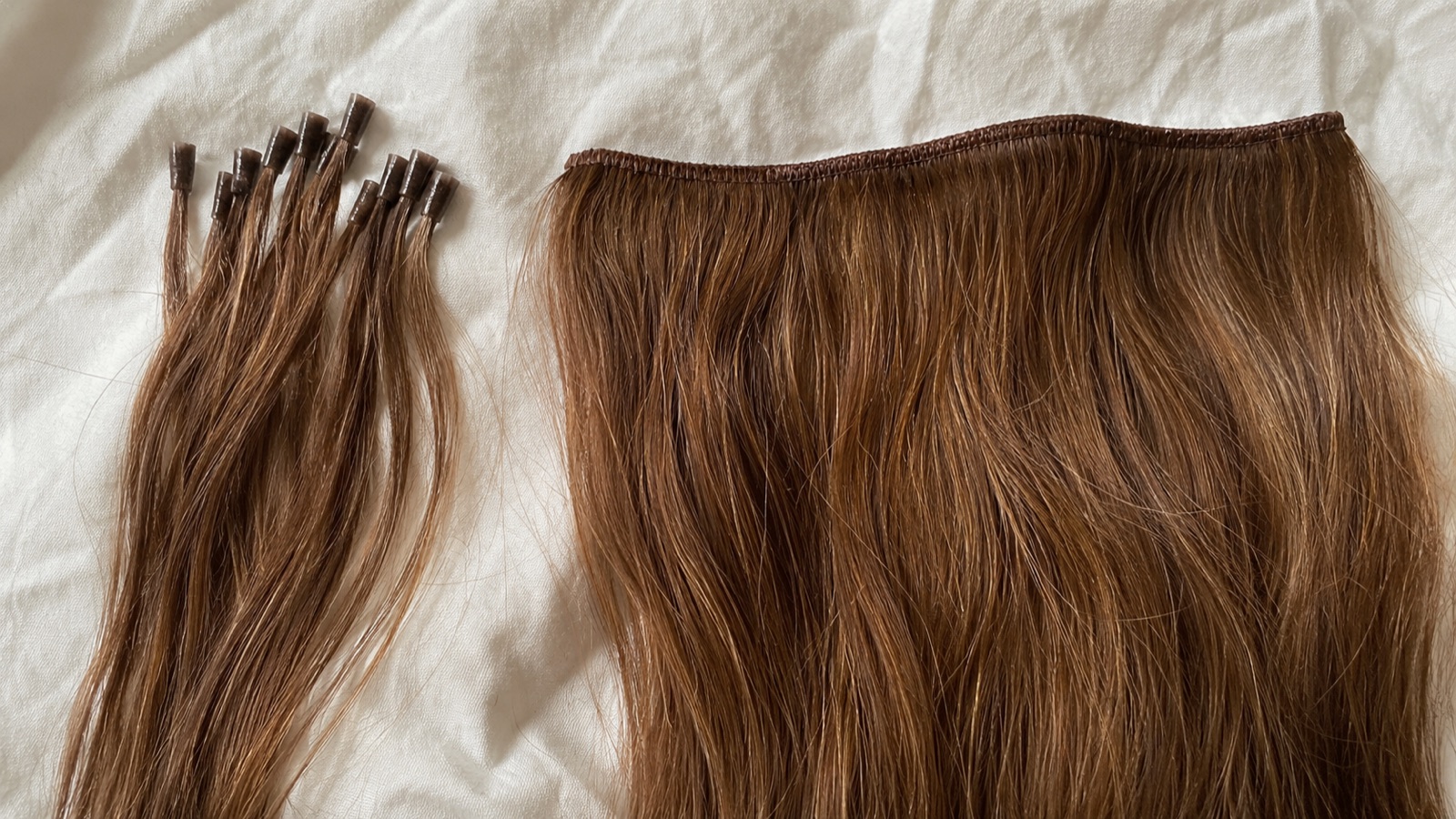
K-tip extensions typically cost $1,500 to $3,500 installed, while a comparable result in hand-tied wefts runs $1,200 to $2,800. The price gap is real but narrower than most clients expect -- and the method that costs more upfront is not necessarily the more expensive choice over 12 months. This breakdown covers what you are actually paying for with each method, where the costs diverge, and which clients end up spending more regardless of what they chose at the first installation.
What You Are Actually Paying For: K-Tips
Keratin tip extensions (also called K-tip, nano tip, or micro-ring application tool depending on bond type) carry a higher per-install price for three compounding reasons.
First, individual bond application is labor-intensive. A full head of K-tips (100 to 150 individual strands, depending on hair density and desired result) takes 3 to 5 hours of installation time. That labor cost is reflected directly in the service price. Weft application for an equivalent result takes 1.5 to 3 hours.
Second, K-tip extension hair is purchased in strands, not grams. A standard K-tip bundle is 100 strands; a full application typically requires 150 to 200 strands for fine to medium density hair. At the premium tier -- Remy human hair with aligned cuticles, sourced from a single donor -- strand bundles run $150 to $300 for 100 strands. Full application hair cost: $225 to $600 per install, excluding labor. Add labor at market rates ($400 to $1,200 for an experienced specialist in a major metro market), and the installed price range becomes $625 to $1,800 at mid-tier and $1,200 to $3,500 at premium.
Third, K-tip maintenance appointments every 8 to 12 weeks average $200 to $600 per visit, depending on whether the bonds are repositioned or replaced with fresh hair. Bonds are typically replaced entirely after 2 to 3 repositioning cycles.
What You Are Actually Paying For: Wefts
Hand-tied weft and machine weft installations cover a wide internal price range depending on construction (hand-tied adds $300 to $600 to a machine weft result for the same application) and attachment method (beads vs. sew-in vs. adhesive weft tabs). A mid-tier beaded weft application for shoulder-to-mid-back length: $900 to $1,600 installed, with $300 to $700 of that being the hair.
Weft hair is priced by weight (grams) and often sold as a full set of 3 to 4 wefts covering 150 to 200g. Good quality weft sets start at $200 and reach $600 to $1,200 for premium double-drawn hand-tied wefts. The labor savings are consistent: wefts lay flat against the head and are secured at intervals rather than individually, which is why even a complex multi-tier weft application finishes faster than a full K-tip install.
Maintenance every 6 to 10 weeks runs $150 to $400 per visit, with the lower end reflecting move-up appointments where the weft attachment points are repositioned without new hair purchase.
Price Range Comparison by Tier
| Tier | K-Tips (installed) | Wefts (installed) | K-Tips (annual maint.) | Wefts (annual maint.) |
|---|---|---|---|---|
| Budget | $800 to $1,200 | $700 to $1,000 | $800 to $1,200/yr | $600 to $1,000/yr |
| Mid-tier | $1,500 to $2,200 | $1,100 to $1,800 | $1,200 to $2,000/yr | $900 to $1,600/yr |
| Premium | $2,500 to $3,500 | $1,800 to $2,800 | $1,800 to $3,000/yr | $1,200 to $2,200/yr |
Annual maintenance assumes 4 to 5 appointments. Hair replacement cost (at full replacement, not reuse) is included in the maintenance range. Most clients replace K-tip hair fully every 9 to 12 months; quality weft hair can be reused across 2 to 4 installs, which compresses the annual cost at mid and premium tiers.
What Drives the Price Up or Down
The largest single cost variable in both methods is the stylist's market and experience level. A certified extension specialist in a major US metro (New York, Los Angeles, Miami) charges $150 to $350 per hour. The same specialist in a secondary market (Charlotte, Nashville, Denver) charges $80 to $180 per hour. Because K-tip installation takes more hours, this variable amplifies the price gap between methods in high-cost markets specifically.
Hair source drives the second-largest price variation. Factory-processed hair with no cuticle alignment: $80 to $150 per 100 K-tip strands. Single-donor Remy with intact cuticle: $200 to $450. The cheaper hair degrades faster (3 to 6 months of wear vs. 9 to 12+), so lower upfront cost often means higher annual cost. The same principle applies to wefts. A $200 machine weft set that needs full replacement every install costs more over 18 months than a $600 hand-tied set reused 4 times.
Removal cost is also underquoted. K-tip removal (dissolving the bonds, detangling each strand) runs $100 to $300 per removal appointment. Weft removal is faster -- typically included in the reinstallation fee or charged at a flat $50 to $100. Over 3 annual cycles, removal costs add $300 to $600 to the K-tip annual cost that most clients do not account for at the initial consultation.
Red Flags That Signal You Are Overpaying
For K-tips: if a full installation quote comes in under $900 in any major market, the low price is coming from either factory-grade hair or compressed installation time (fewer strands, less coverage). Both result in visible sparseness at the ends and premature tangling. An experienced specialist doing 150 strands of quality hair correctly cannot physically deliver that service at under $900 and cover costs.
For wefts: an artificially low weft quote (under $700 in a major metro) typically means either machine weft being quoted as hand-tied, or a single-layer application that will have visible tracks. Read reviews specifically for "tracks showing" or "you can see the beads" -- these are method-appropriate applications that simply did not use enough hair or installed it at the wrong density.
For both methods: any quote that does not separate the hair cost from the labor cost is making it impossible to compare accurately. A $1,500 "all-in" quote might be $400 in hair and $1,100 in labor (solid) or $1,200 in hair and $300 in labor (lower-experience or high-volume approach). Ask specifically. Read our assessment of what salons actually see with DIY extension attempts to understand what cutting cost at the skill end actually produces.
How to Budget for This
A realistic first-year budget for either method includes: installation, hair, 3 maintenance appointments, and one full removal. For mid-tier quality:
- K-tips first-year all-in: $2,800 to $4,200 (installation + hair + 3 maintenance + 1 removal)
- Wefts first-year all-in: $2,100 to $3,200 (installation + hair + 3 maintenance + 1 removal, with 1 to 2 hair reuses factored in)
If the weft hair is high quality and reused through years 2 and 3, the annual cost in year 2 and 3 drops to $900 to $1,600 for maintenance only. K-tips do not reuse the same way; year 2 and 3 costs hold relatively flat.
Is K-Tip Worth the Premium Over Wefts?
For the right client: yes. K-tips are unmatched for fine hair clients who cannot tolerate any weft bulk, clients with active lifestyles who need maximum individual strand movement, and clients with very specific density placement needs (hairline edges, specific thinning zones) where individual strands are the only way to place extensions precisely. For these clients, the premium is not optional -- wefts physically cannot achieve the same result.
For the average first-time extension client with normal density hair wanting 4 to 6 inches of length and moderate volume: quality wefts deliver an equivalent result at lower first-year cost, lower maintenance frequency, and better reuse economics. The K-tip premium buys precision and flexibility that most clients do not need enough to justify the consistent price difference at every maintenance cycle.
The method decision should be driven by hair type and lifestyle, not which one sounds more premium. See our full breakdown of micro-link options for fine hair for a related comparison that addresses a common overlap question.
Disclosure: This post contains affiliate links. We may earn a small commission at no additional cost to you if you purchase through our links.