Micro Point Links for Fine Hair: What the Technique Actually Delivers
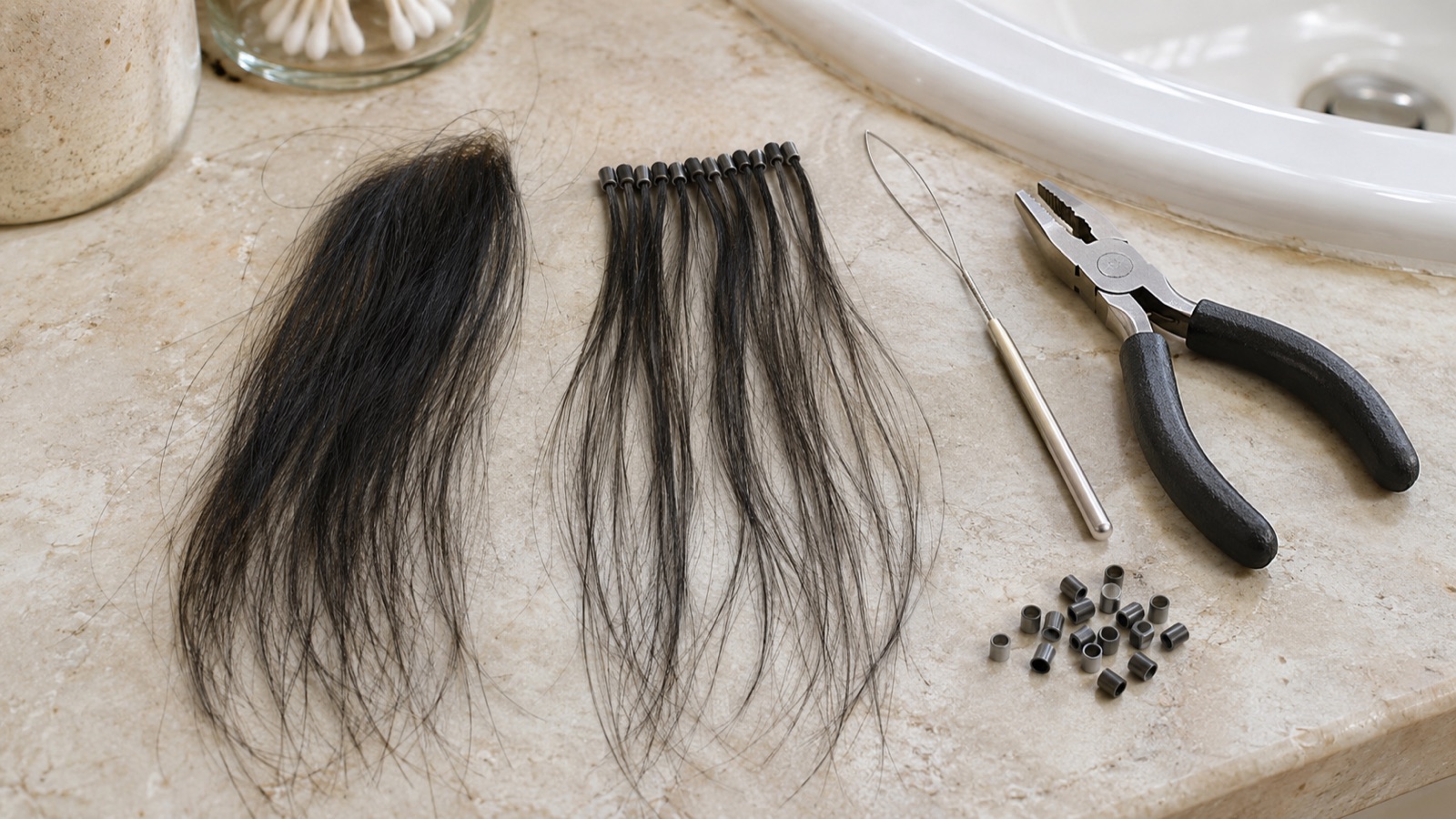
Micro point links get recommended constantly for fine hair, often without enough honest qualification about when they work and when they don't. The pitch — small metal beads, no heat, no glue, virtually invisible — sounds ideal for someone with thin, fragile hair who has been told she's not a candidate for most extension methods. Our assessment: micro point links are one of the better options for fine hair, but only when the installation is technically correct and the client's hair density meets the minimum threshold. Below that threshold, no method works well, including this one.
What Micro Point Links Are (And What Makes Them Different)
Micro point links — also called micro loop extensions, micro bead extensions, or micro-ring application tool extensions — are individual strand extensions attached using a small metal bead or ring that's crimped around both the extension strand and a small section of natural hair. No adhesive. No heat at the attachment point. The connection is entirely mechanical.
The "micro" in the name refers to the size of the bead: typically 3.5mm to 4mm in diameter, compared to the 5 to 6mm standard used in larger i-tip and copper tube extensions. That smaller bead size is directly relevant to fine hair because less metal means less weight at the attachment point, and the bead sits closer to the scalp without creating visible lumps under thin hair.
The extension strand itself is an i-tip — a pre-tipped strand, usually 0.5 to 1 gram, with the metal bead pre-attached. Stylists install them with a loop tool (a thin wire needle that threads through the bead), pull the natural hair section through, insert the extension strand, and crimp the bead closed with pliers. A skilled stylist completes a full head in two to three hours. Move-ups happen every six to eight weeks as the natural hair grows and the bead slides down.
The no-heat, no-glue characteristic is the clinically relevant advantage for fine hair. Keratin bond extensions require heat at application and removal, which creates cumulative stress on fragile strands. Tape-ins use adhesive that must be dissolved with chemical remover. Micro point links skip both of those stress events entirely — installation, adjustment, and removal are mechanical only.
The Real Minimum Hair Density for Micro Point Links
Fine hair and thin hair are not the same thing, and the distinction matters here. Fine hair describes strand diameter — individual strands are smaller in circumference, which means they're more susceptible to breakage from weight and tension. Thin hair describes density — fewer strands per square centimeter of scalp. A client can have fine-textured hair at moderate density (workable) or fine-textured hair at low density (not workable with any method that adds weight).
The practical minimum for micro point links is somewhere around 100 to 120 strands per square centimeter at the mid-scalp. Below that, the natural hair sections available for attachment are too small to distribute the weight of the extension strand without putting the entire load on two or three follicles per bead. That's a formula for traction alopecia, regardless of how small the bead is.
A reputable extension stylist should perform a density assessment before quoting or booking. The assessment takes three minutes — parting, looking at the scalp exposure, and assessing the size of natural hair sections available. Any stylist who agrees to install micro point links on genuinely thin hair without doing this assessment is taking on risk on behalf of the client.
For fine hair at adequate density, the method performs well. Individual strand extensions distribute their weight across many attachment points rather than consolidating it the way weft rows do, which means each follicle bears less load. A properly installed set of micro point links at 0.5 to 0.7 grams per strand adds significantly less tension per follicle than a row of hand-tied weft at equivalent volume.
Installation Variables That Determine Whether Fine Hair Can Handle This Method
Strand weight is the single most controllable variable. Most micro link extensions on the market come in 0.5g, 0.7g, and 1g strand weights. For fine hair, 0.5g strands are the correct choice without exception. One gram strands, while common in standard installations, are too heavy for fine hair at most density levels. Stylists who install 1g strands on fine hair to reduce installation time are shifting the risk of breakage entirely onto the client.
Section size matters equally. Each natural hair section connected to an extension strand should be roughly three times the weight of the extension strand — so for a 0.5g extension, the natural hair section should contain approximately 1.5g of hair, which is a meaningful amount of fine hair. If the sections are too small, the anchor is insufficient. If sections are too large, the bead is over-crimped and damages the hair in a different way.
Bead placement location — how far from the root the bead is positioned — affects both comfort and longevity. For fine hair, closer to the scalp (within 1 to 1.5 cm) means the extension weight is distributed closer to the follicle, reducing the lever-arm effect that causes fatigue and breakage mid-strand. The tradeoff is that close placement means the bead becomes visible faster as hair grows and move-up appointments become more frequent.
What Micro Point Links Won't Fix
The most common consumer misconception is that micro point links add visible density regardless of the client's starting point. They add length more reliably than they add density. For a client who wants to appear to have significantly more hair — not just longer hair — the individual strand format at 0.5g per strand requires a high strand count (150 to 200 strands or more) to achieve visible density. At $5 to $10 per strand at the service level, that's $750 to $2,000 in service cost for full volume, before the hair itself.
Some stylists argue that nano ring extensions are always superior to micro links for fine hair because the bead is even smaller (2mm versus 3.5mm). They're right about the bead size and wrong about the practical conclusion. Nano rings use a thinner extension strand, which means the hair quality and lifespan are reduced. For clients prioritizing hair quality and longevity over the smallest possible bead, micro point links at the appropriate strand weight are often the better trade.
Color matching is harder with individual strand methods than with weft methods. Each strand has to blend into the natural hair, which means highlighting, lowlights, or dimensional color in the natural hair creates matching complexity that flat-color weft extensions avoid. Fine hair clients often have subtle dimension in their natural hair from sun exposure or previous color — a flat brown extension strand blends poorly into naturally dimensional hair regardless of how light the bead is.
What the Cost Actually Looks Like
A full micro point link installation for fine hair runs $400 to $900 for the service, depending on market, stylist experience, and strand count. Hair cost is additional — quality micro link hair runs $200 to $500 per head of hair depending on length and quality tier. Initial total for fine hair clients seeking a noticeable change: $600 to $1,400.
Move-up appointments at six to eight weeks run $150 to $300. Fine hair clients who prioritize hair health often schedule more frequently — at six weeks rather than eight — which puts the annual maintenance cost at roughly $1,200 to $2,400 in move-ups alone, not including hair replacement when strands near end of life.
The investment is real. Clients who understand the cost structure before the first install are far more likely to maintain the method correctly and see the multi-year value. Clients who are surprised by move-up costs abandon maintenance and end up with matted hair at the bead that requires professional emergency removal.
How long do micro point link extensions last in fine hair?
The hair itself lasts six to twelve months with proper care before quality degrades noticeably. Fine hair clients who heat-style frequently or use sulfate-heavy shampoos see faster degradation. Move-up appointments every six to eight weeks are required to reposition beads as natural hair grows. The method isn't self-maintaining — without regular move-ups, the bead slides down the strand and creates matting.
Can micro point links cause hair loss in fine hair?
They can, when installed incorrectly or on hair that doesn't meet the minimum density threshold. The risk factors are strand weight too heavy for the natural hair section size, sections that are too small to support the extension weight, and move-up appointments deferred past eight weeks (which causes the extension strand to tension the natural hair as the gap widens). A correctly installed set on appropriate hair density with maintained appointments does not cause hair loss in the available evidence.
What's the difference between micro links and nano rings for fine hair?
Nano rings use a 2mm bead compared to the 3.5mm micro bead — smaller and less visible. The tradeoff is that nano ring strands are thinner (0.3 to 0.4g versus 0.5g), which means reduced hair quality and shorter lifespan. For a client with extremely fine hair who needs the smallest possible attachment point, nano rings are worth considering. For most fine hair clients, micro point links at 0.5g deliver a better quality-to-visibility ratio and longer strand longevity.
Do you need special shampoo for micro point link extensions?
Yes. Sulfate-free shampoo is required to preserve both the extension hair quality and the metal bead integrity (sulfates accelerate bead corrosion on cheaper rings). A clarifying shampoo can be used occasionally — monthly or at move-up appointments — but not as the regular wash. Extension-safe conditioner on mid-shaft and ends, never on the bead attachment zone. Fine hair clients who use volumizing shampoos with silicone buildup should switch — buildup at the bead line causes the section to feel rough and the bead to slip faster.
Micro point links are a legitimate, well-suited method for fine hair when the client meets the density minimum, the stylist uses appropriate strand weights, and the maintenance schedule is followed. The method has real limitations — they're not invisible on all hair, color matching is complex, and individual strand methods require higher strand counts for visible volume gains. For clients who understand those constraints and want a heat-free, glue-free option that distributes weight across many attachment points, micro point links represent a sound choice. The critical step is finding a stylist who does a density assessment before booking and installs at the correct strand weight for the client's hair. Certified Hair Pro is a verified directory where consumers can search for credentialed extension specialists by method and location.
Disclosure: This post contains affiliate links. We may earn a small commission at no additional cost to you if you purchase through our links.